Deploying outreach agents before formal oversight arrives
The Dutch DPA has a new directorate for AI oversight, but formal supervision is not in place yet. Here is how to deploy an outreach agent responsibly today: the agent prepares, a human decides.
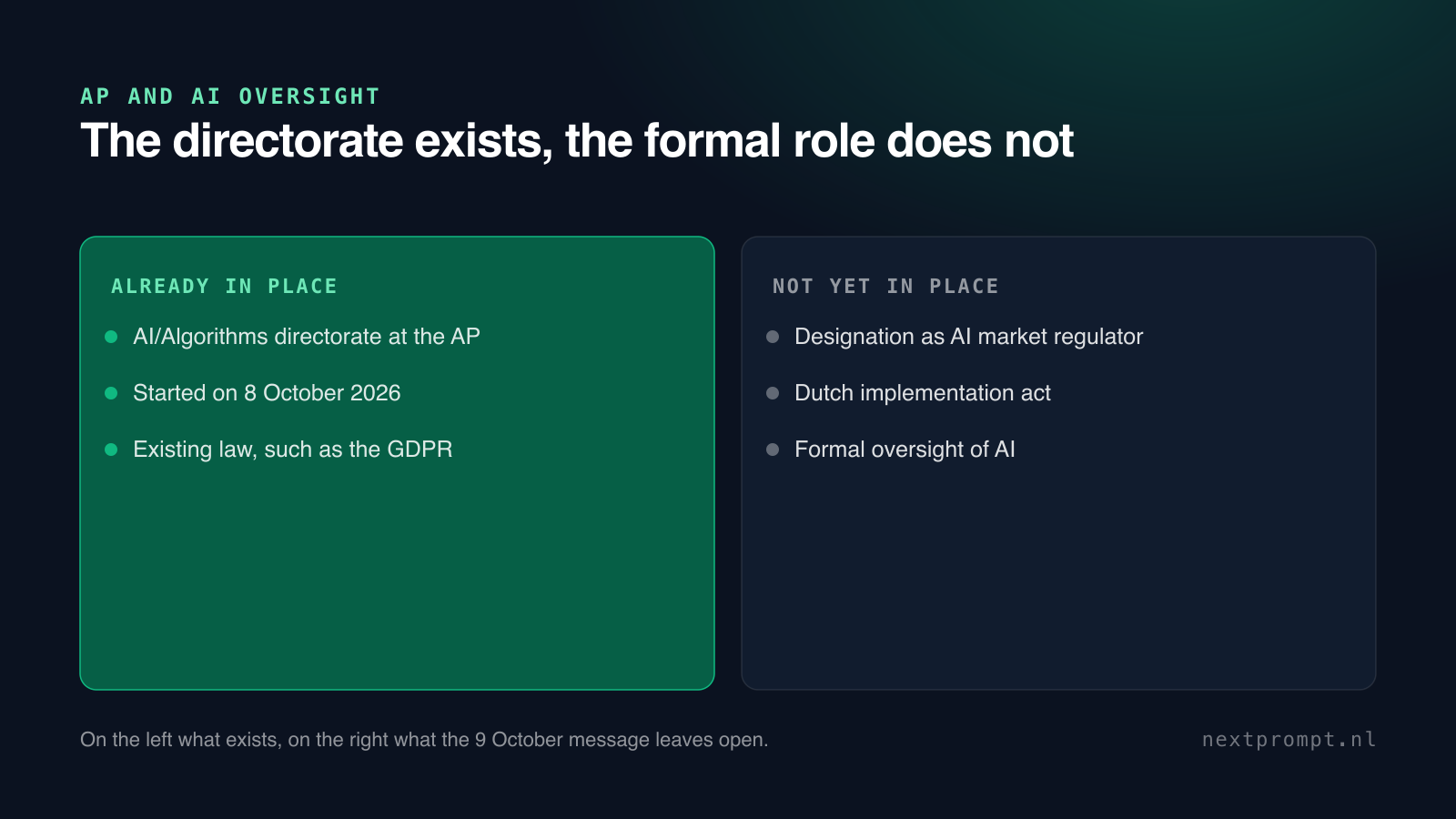
On 8 October 2026 the Dutch Data Protection Authority (Autoriteit Persoonsgegevens, AP) started a new directorate for Oversight and Coordination of AI/Algorithms. That is a clear signal. It does not mean formal AI oversight is in place yet. Waiting for the rules is not a plan. Human approval up front is.
What is changing, and what is not yet
The AP's message of 9 October states that the AP is not yet a designated AI market supervisor. The Dutch implementation act does not apply yet either. So the directorate exists, but the formal role and the law around it do not yet.
At the same time, the AP points to recent incidents. They show that AI agents can gain unauthorised access to online environments. That matters for anyone who lets an agent act outside their own chat window.
Do not read this as a free pass. An empty oversight space does not mean there are no rules. Existing legislation applies, such as the GDPR as soon as you process personal data. We are not lawyers. Always put your specific situation to your own privacy or legal adviser.
Where it affects you: outreach
Outreach looks harmless, but it is more sensitive than it seems. You send a message to a real person, in the name of your organisation. A mistake does not cost you internal time. It costs trust with a publisher, editor or partner.
With an agent that writes and sends outreach, there are three risks to cover up front:
- Content and sender: the message says something untrue, or does not sound like your organisation.
- Personal data: you store and use the contact details of individuals. That falls under the GDPR.
- Repetition: the same publisher is approached twice, by different people or at different moments.
For government organisations there is an extra reason. You are accountable for how you communicate with citizens and organisations. A human who explicitly signs off makes that accountability easier.
An agent prepares. A human decides.Ontwerpprincipe
How SEO strategist is built for this
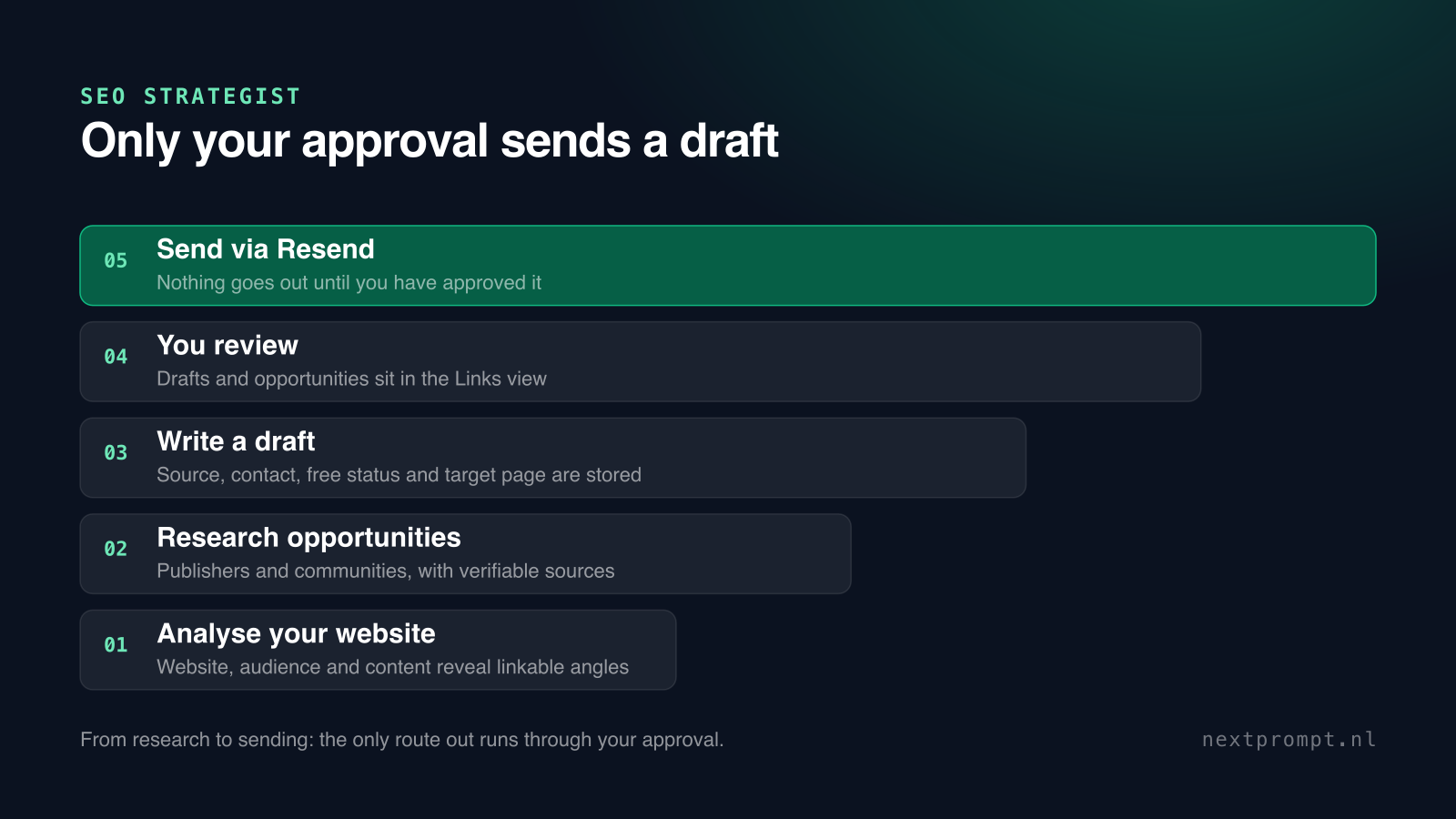
The SEO strategist is our link building agent. It researches your website, finds relevant free link opportunities and writes personal outreach emails. The key design choice is in its description: the opportunities and drafts live in the Links view, and only your approval sends them via Resend.
Preparing is not sending
The agent writes drafts. It does not send anything itself.
Sending only happens after you have approved a draft.
What does the agent do in practice?
- It analyses your website, audience and existing content to find linkable angles.
- It researches relevant publishers, resource lists, communities and free submission routes, with verifiable sources.
- It writes personal outreach drafts and stores the source, contact person, free status and desired target page.
- It can run recurring research through Tasks and avoids approaching the same publisher twice.
That maps onto the three risks above. You read the content before anything leaves. The source and contact person are stored with every draft, so you can check why someone is being approached. And protection against duplicate outreach is built into the agent itself.
On the access issue raised in the AP message: the agent works with web search and by reading a web page you give it. Nothing in this agent's tool list lets it log in to other people's environments. The list also includes tools for documents, presentations, Python calculations and bringing in a fellow specialist. That does not make risks disappear. It means the access surface is small and known.
What you can do yourself
A supplier's good design choice does not replace your own agreements. As an SME owner or government team you can arrange this today, without waiting for oversight:
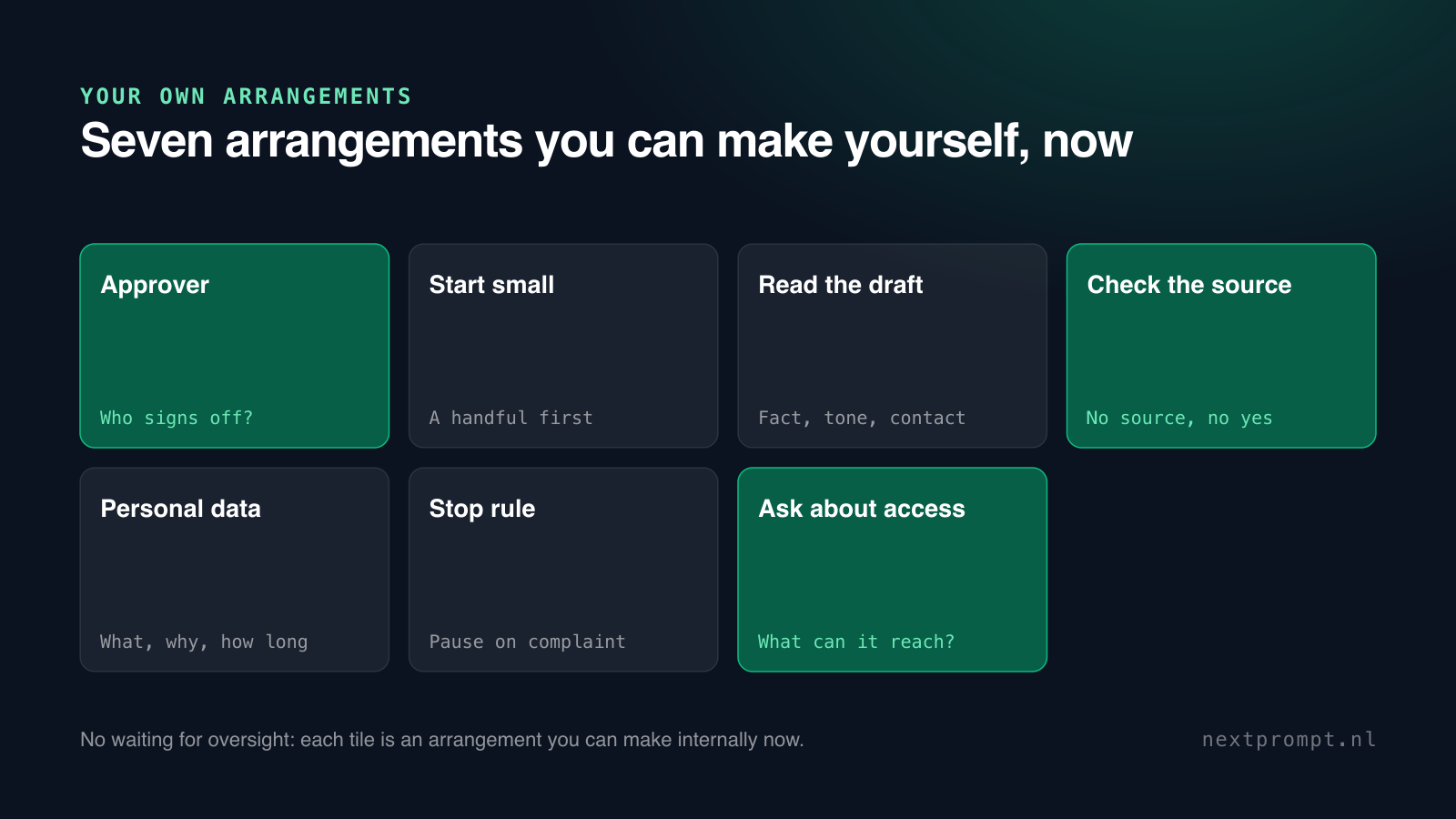
- Appoint an approver. Decide who may release drafts and who covers during absence.
- Start small. Let the agent prepare a handful of opportunities and judge the quality before you scale up.
- Read every draft on three points. Are the facts right, does the tone fit, is the chosen contact person the right one?
- Check the source. Do not approve an opportunity without a verifiable source.
- Record what you do with personal data. Which data do you store, why, and for how long? Discuss this with your privacy adviser.
- Set a stop rule. Decide in advance when you pause a campaign, for example after a complaint or an error in a message.
- Ask your supplier about access. Which tools does an agent have, what can it reach, and what only happens after your approval?
The last question applies to every agent you deploy, not only ours. In doubt? Have an AI scan done. If a supplier cannot say clearly what an agent can reach, that is an answer in itself.
What we commit to, and what we do not claim
We follow the same rule as in every article: only what we can support. What we commit to in the design of SEO strategist:
- Drafts and opportunities live in the Links view, where you review them.
- Only your approval leads to sending via Resend.
- With every draft we store the source, contact person, free status and desired target page.
- The agent watches for duplicate outreach to the same publisher.
What we do not claim: that this makes you compliant automatically. Compliance depends on how you deploy the agent, which data you use and which internal agreements you make. We also do not claim to know what the AP or the implementation act will look like. That has not been settled yet.
The direction is clear, though. Oversight is coming, the AP is already building a directorate for it, and the incidents around unauthorised access have been named. If you already work with a human in the loop, you will not have to rebuild later.
In short
- Since 8 October 2026 the AP has a directorate for Oversight and Coordination of AI/Algorithms, but it is not yet a designated AI market supervisor.
- The Dutch implementation act does not apply yet. Existing rules, such as the GDPR, do.
- Outreach touches content, personal data and repetition. Human approval covers the first and the last.
- SEO strategist prepares opportunities and drafts in the Links view. Only your approval sends via Resend.
- Appoint an approver, start small, read every draft and ask your supplier what an agent can reach.

Translates AI into what it actually returns on the work floor. Writes about the agents we run, what they may and may not do, and what that costs.
All articles by this writer →