Legitimate interest for AI helps, but the GDPR stays in force.
Coreper gave the Council a mandate on the Digital Omnibus, and member states back legitimate interest as a GDPR basis for AI. Here is what it means for SMEs and government that let an agent search for companies and enrich contact persons.
On 21 October 2026 Coreper gave the Council a negotiating mandate on the Digital Omnibus. Member states support a GDPR basis of legitimate interest for AI. If you let an agent like the Sales assistant search for companies and enrich contact persons, that sounds like good news. It is mostly a signal. Your day-to-day rules do not change because of it yet.
What was decided on 21 October
Coreper is the body of permanent representatives of the member states in Brussels. A negotiating mandate means the Council now has a common position to negotiate with the European Parliament. It is not a law. The proposal itself comes from the European Commission's digital package, which the Dutch Senate (Eerste Kamer) follows under dossier E260003.
According to iBestuur, EU countries want to relax the privacy rules for AI. Council and Parliament still have to agree before there is a text, and that text may differ in places from what is on the table now. For you that means: do not plan around a rule that does not exist yet.
Legitimate interest: what it already was and what it will not become
Legitimate interest already exists as a basis in Article 6(1)(f) of the GDPR. You need a concrete interest, the processing must be necessary for that interest, and you weigh it against the interests and rights of the people whose data you use. The line in the Omnibus is to make that basis more explicit for AI. It is not a free pass: the balancing test stays.
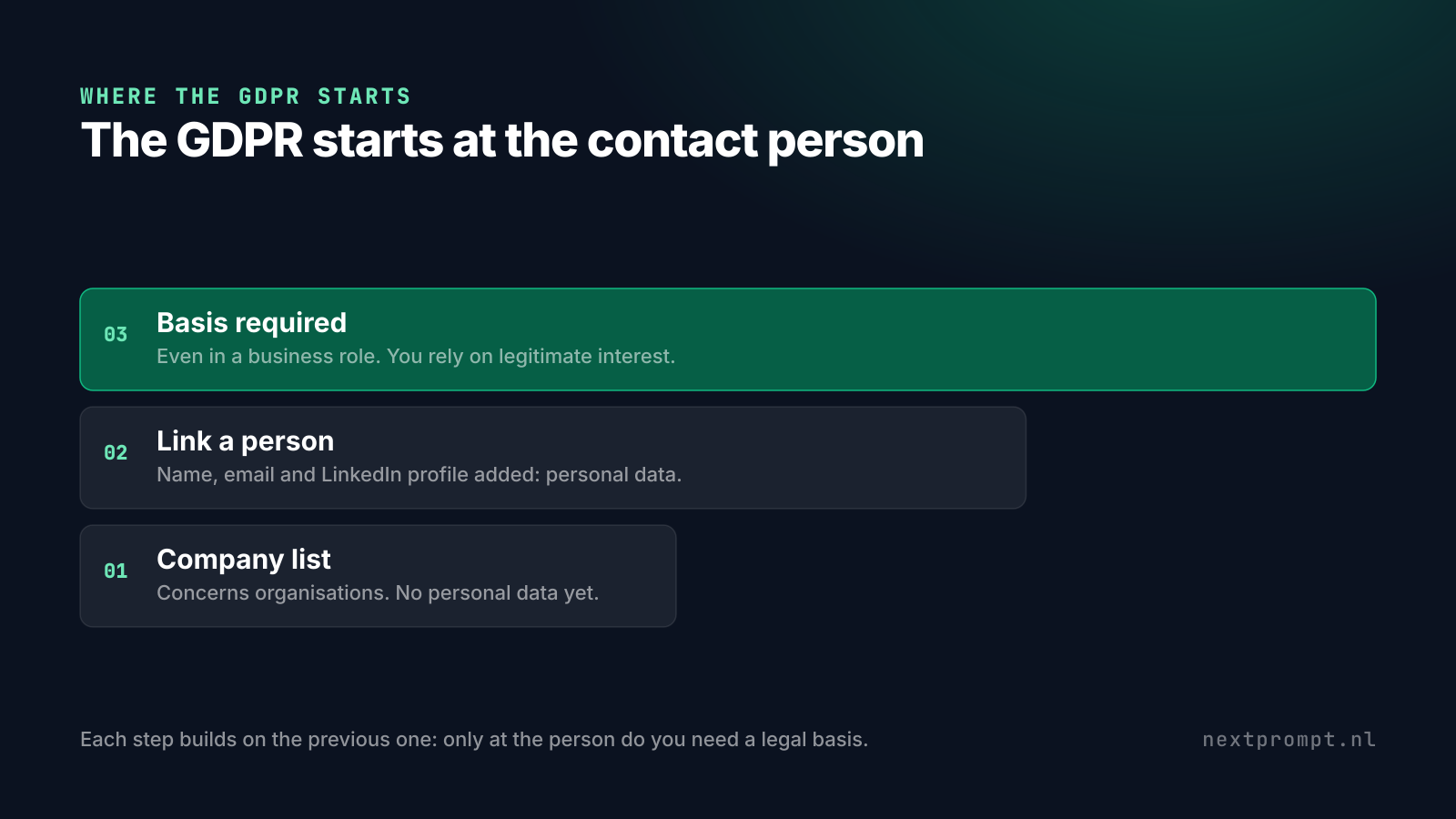
Also note where the GDPR starts. A list of companies that fit your target group, as in your Companies view, is about organisations. Once an agent attaches a contact person with a name, email address and LinkedIn profile, as in your Contacts view, you are dealing with personal data. That holds even when the person acts in a business role. From that step on you need a legal basis.
An honest caveat: as far as is known now, the new basis concerns the development and operation of AI. Whether sales research with an agent as a tool falls under it literally depends on the final text. For this kind of processing you work with the existing legitimate interest today, with the balancing test on paper.
What still applies
Whatever the Omnibus delivers, these rules stay in place:
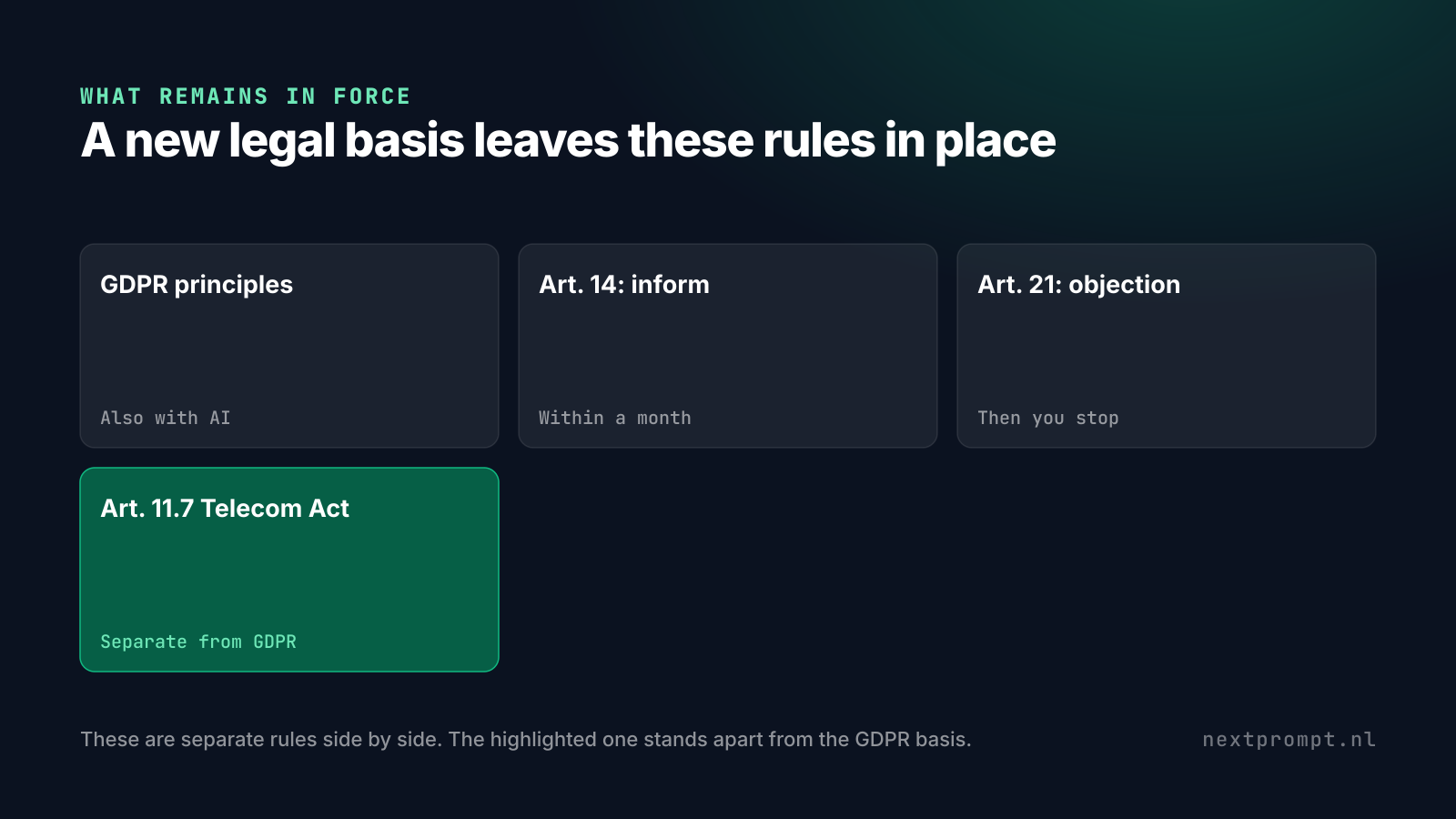
- GDPR principles. Purpose limitation, data minimisation, a retention period and transparency apply to every processing operation, with or without AI.
- Information duty (Article 14 GDPR). If you do not collect data from the person directly, you must inform that person: within a reasonable period and at the latest within a month. If you use the data to contact them, at the latest at the first message.
- Right to object (Article 21 GDPR). A person can always object to direct marketing. Then you stop.
- Article 11.7 of the Dutch Telecommunications Act. This covers unsolicited commercial messages, such as email, text messages and automated calling systems. Consent is the starting point, with exceptions. It is a separate instrument alongside the GDPR, so a new GDPR basis does not change it. How it works out for business recipients, you check against the current text. Overloop describes the rules for the Netherlands and Belgium in its overview on cold outreach.
Searching is not mailing
Separate two steps. Searching for companies and enriching contact persons falls under the GDPR. Approaching someone also falls under Article 11.7. A good basis for the first step therefore gives you no permission for the second.
Government has an extra point to watch. The GDPR provides that legitimate interest does not apply to processing by public authorities in the performance of their tasks. So read what ends up in the final AI provision before you build on it. If you work at a municipality or implementing body, first record your task and your legal basis. How to structure that kind of question is visible in the training at Gemeente Helmond.
How the Sales assistant is built
The Sales assistant drafts target groups from your product page or brochure: which markets, with which search terms and what he scores on. He then searches daily for companies per target-group segment, enriches them with contact person, email and LinkedIn, and writes qualified leads to your Leads view.
That design fits the rules that stay. A segment is a recorded purpose, so you can show what you are searching for. The agent only enriches what belongs to a lead: contact person, email and LinkedIn. And everything comes together in one place that you can review.
A lead is a proposal to seek contact, not permission to send an email.Design principle
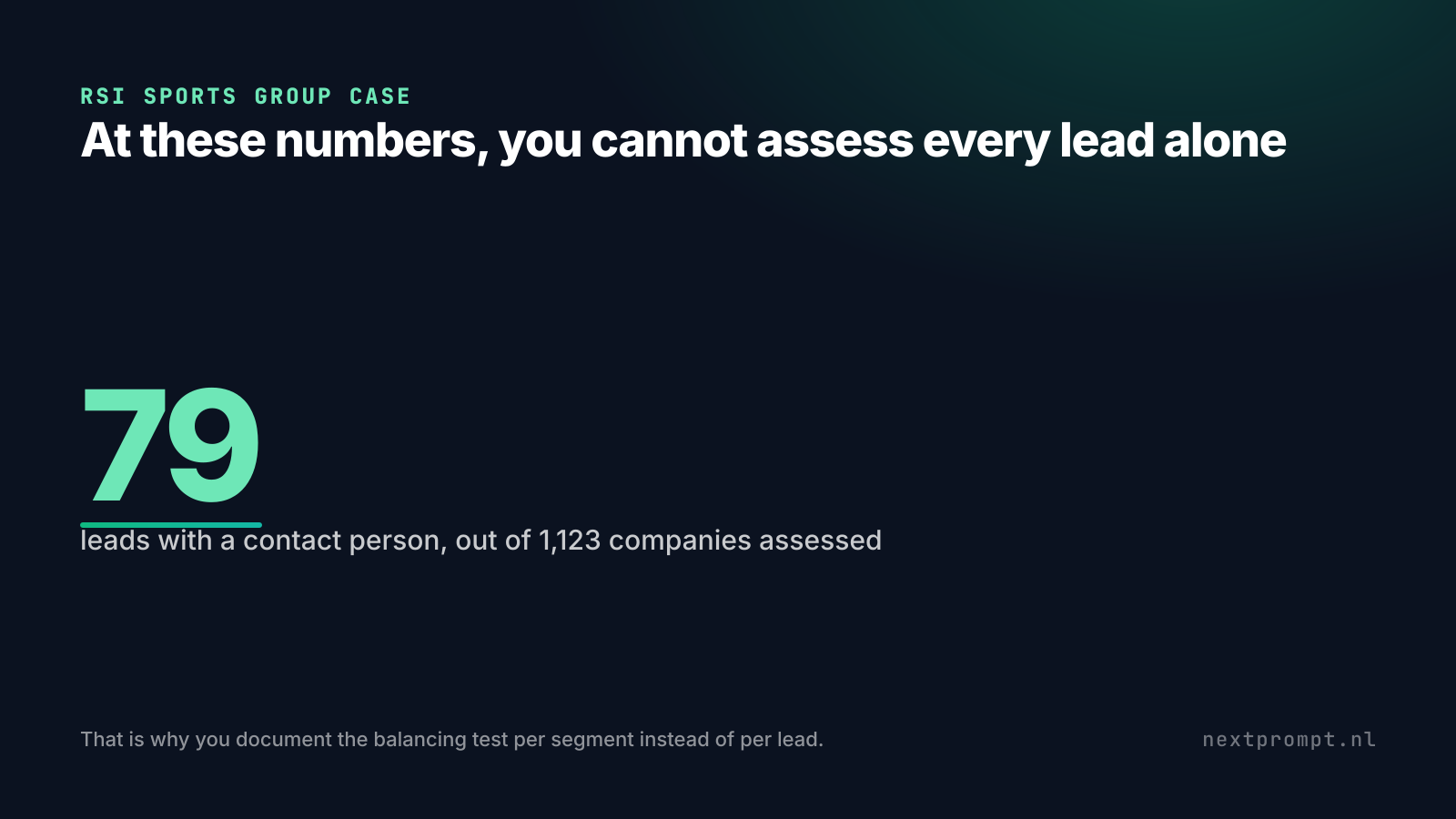
In the RSI Sports Group case, 1,123 companies were assessed and 79 leads with a named contact came out. At those numbers a recorded balancing test is no formality, because you cannot assess every lead separately. You can connect the agent to sources and systems you already use, such as KvK, Graydon, LinkedIn and HubSpot.
What you can do yourself
You do not have to wait for Brussels. These steps work under today's rules and remain valid if the relaxation arrives:
- Write down the purpose per segment: which companies, why and which roles.
- Record the legitimate interest balancing test in writing: your interest, the necessity and what the person can reasonably expect.
- Limit the data to what you need, such as a business role and a business address.
- Set a retention period for leads you do not follow up.
- Arrange the information duty and a simple way to object.
- Have a human review every first message and check whether Article 11.7 allows sending it.
If you want to go through this together, start with an AI scan or a training for your team.
What we commit to
We build the Sales assistant on today's rules and treat the Omnibus as a proposal until a final text exists. When it arrives, we review our choices again.
We wrote earlier about outreach and human approval: Deploying outreach agents before formal oversight arrives. For AI literacy, read AI literacy starts in your inbox.
Unsure about your situation?
Bring your use case via contact. We help think through the setup, for example in a roadmap and pilot. We do not give legal advice: for your final legal basis, consult your own lawyer or data protection officer.
What to take away
- Coreper's mandate of 21 October 2026 is a negotiating position of the Council, not a law.
- Legitimate interest already exists in the GDPR. The balancing test stays, even if AI is mentioned more explicitly.
- Once an agent attaches a contact person, you are dealing with personal data. Articles 14 and 21 GDPR still apply.
- Article 11.7 of the Telecommunications Act is a separate instrument. Searching and enriching is something other than approaching someone.
- Public authorities cannot use legitimate interest in the performance of their tasks. Wait for the final text.

Translates AI into what it actually returns on the work floor. Writes about the agents we run, what they may and may not do, and what that costs.
All articles by this writer →